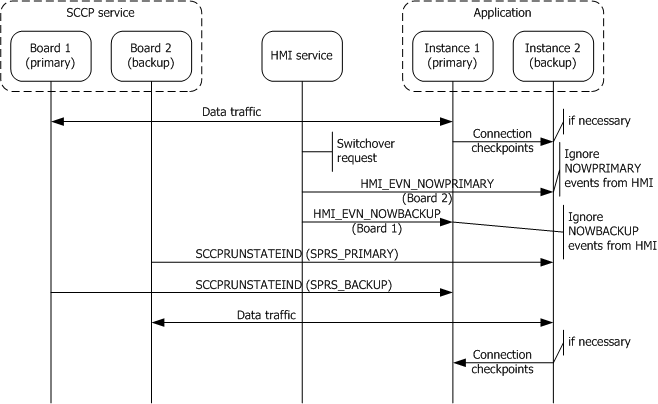
Switchover processing is initiated when an application receives a SCCPRUNSTATEIND event with a new state that differs from the previous state of that board.
For a single-node application that opens both boards, the application receives a SCCPRUNSTATEIND event (SPRS_PRIMARY) for the previously backup board and a SCCPRUNSTATEIND event (SPRS_BACKUP) for the previously primary board. These event indications can occur in either order, depending on how the switchover was initiated. For a dual-node architecture, the application instance receives only the new run state indication for its own board.
For connectionless traffic, there is no special processing that the application must undertake other than to redirect its traffic to the new primary board. Connectionless messages that were in progress prior to the switchover may be lost, so the application must be able to recover from lost messages.
For connection-oriented traffic, only confirmed connections are maintained by the SCCP layer across a switchover. Any transient connections (those in connecting state or in releasing state) are discarded. Resources associated with transient connections are recovered by protocol timers and the SCCP layer inactivity timers, transparently to the applications.
Therefore, a dual-node application employing connection-oriented services must implement some mechanism, such as sending checkpoint messages, to reflect the state of active connections from its primary instance to its backup instance. It is only necessary to checkpoint connection states when the connection is confirmed and released. For a single-node application that opens both boards, it may be necessary to examine connection tables and delete connections that were in the connecting or releasing states at the time of the switchover.
In some switchover cases, due to timing windows, it is possible that the SCCP layer view of which connections are active differs from the application view. To prevent the stranding of resources in the SCCP layer due to these timing windows, the application must implement the SCCP application inactivity timing facility and/or the connection auditing facility described in the Dialogic® NaturalAccess™ SCCP Layer Developer's Reference Manual.
The following illustration shows the operations that occur during SS7 SCCP switchover processing: