Design the 3G-324M Interface channel configurations based on the media codecs selected and whether audio transcoding is required.
There are two types of configurations you can set up:
A pass-through configuration, when no audio transcoding is required.
An audio transcoding configuration, which is required when audio transcoding to G.711 or another supported Fusion codec is to be performed.
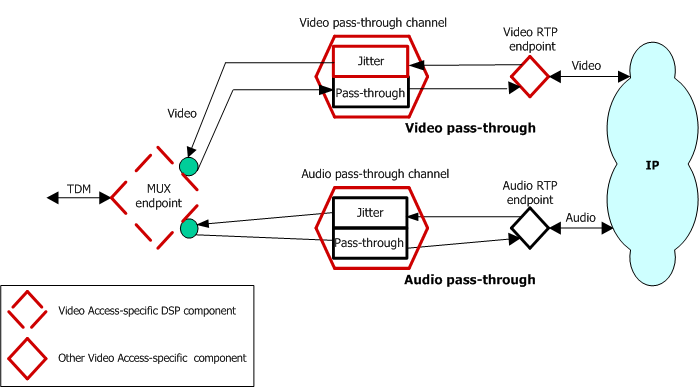
If audio transcoding is not required, the application must create the following for each 3G-324M port:
A MUX/DEMUX endpoint, associated with a PSTN timeslot. The remainder of this manual refers to the MUX/DEMUX endpoint as a MUX endpoint.
A video pass-through channel and a video RTP endpoint (MPEG-4, H.263, or H.264).
An audio pass-through channel and a Fusion audio RTP endpoint.
The video channel must connect with the MUX endpoint and the video RTP endpoint. The audio channel must connect with the MUX endpoint and the audio RTP endpoint. Both pass-through channels must then be enabled.
The following illustration shows a pass-through full-duplex configuration (simplex configurations can also be used):
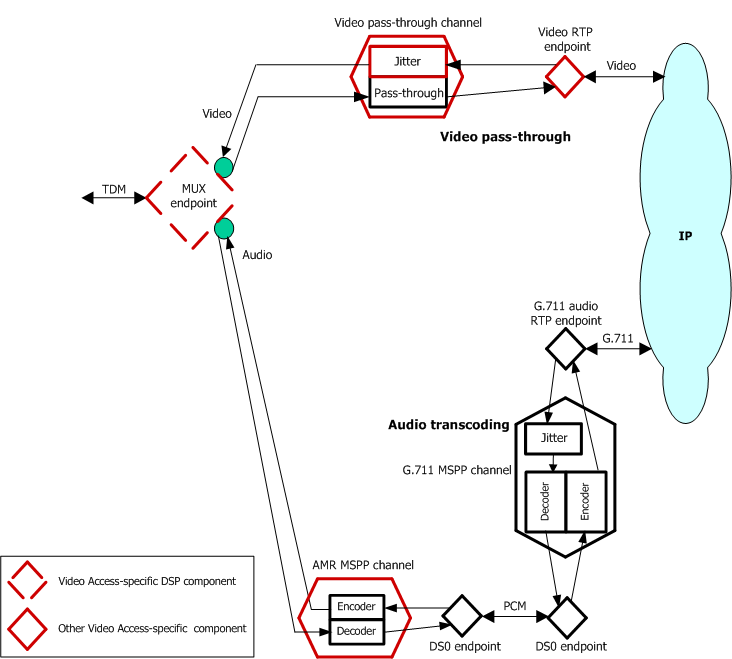
If the application requires G.711 encoded RTP packetized audio on the IP side, then you must do the following:
Select the AMR audio codec on the 3G-324M side.
Create an AMR MSPP channel and a G.711 MSPP channel between the respective sets of endpoints, as illustrated in the diagram below.
Use TDM switching to connect the two DS0 endpoints. This completes the path between the MUX endpoint and the RTP endpoint.
Connect the AMR MSPP transcoding channel to the Demux prior to starting the 3G-324M negotiation.
The following illustration shows a full-duplex audio transcoding configuration. (Simplex configurations can also be used.)