This topic describes:
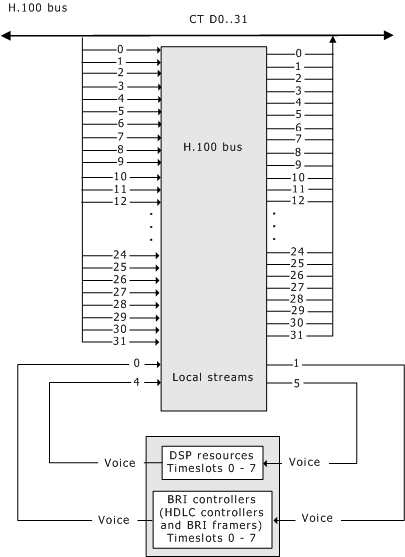
The specific use of each stream, as shown for H.100 streams and local streams
An illustration of the AG 2000-BRI switch model
|
H.100 streams |
|
|---|---|
|
H.100 bus |
Streams 0..31, timeslots vary based on clock rate: Streams clocked at 8 MHz: timeslots 0..127 Streams clocked at 4 MHz: timeslots 0..63 Streams clocked at 2 MHz: timeslots 0..31 |
|
Local streams |
|
|---|---|
|
Line interface voice in and out |
Streams 0 and 1, timeslot 0..7 |
|
DSP voice in and out |
Streams 4 and 5, timeslot 0..7 |
If you have an AG 2000-BRI board in the same chassis as a CG 6000 board and you want to pass data through all streams on the board, you must set the H.100 stream speed to 8 Mbit/s for all 32 streams on the AG 2000-BRI board.
The default stream speed for all streams on a CG 6000 board is 8 Mbit/s. On AG 2000-BRI boards, the default speed for streams 0 through 15 is set at 2 Mbit/s, while the default stream speed for streams 16 through 31 is set to 8 Mbit/s. Therefore, before using streams 0 through 15 to pass data, you must reset the speed for these streams to 8 Mbit/s.
To reset the stream speed, use the swiConfigStreamSpeed function in the Switching service or the swi.ConfigStreamSpeed command in the swish utility. For more information, refer to the Switching Service Developer's Reference Manual.
The following illustration shows the AG 2000-BRI switch model:
AG 2000-BRI switch model
Switching on the AG 2000-BRI board is implemented by the HMIC chip. The HMIC chip can perform local bus to local bus switching in full non-blocking fashion.
The number of H.100 connections is limited to a maximum of 128 full duplex or 256 simplex (or half-duplex) connections, in any combination, from either:
H.100 bus to the local bus, or
H.100 bus to H.100 bus
There are no restrictions on local switching. Any local device can be connected to any other local device.