The AG 2000 board is part of the Alliance Generation family of telephony boards. It provides up to eight analog line interfaces with up to eight ports of call processing and programmable voice processing.
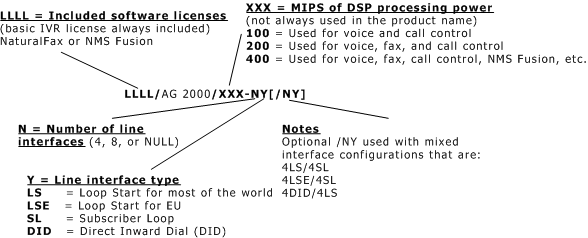
The following illustration shows the available AG 2000 board types:
Refer to www.dialogic.com/declarations/default.htm for a list of available AG 2000 board configurations, for a list of countries where Dialogic has obtained approval for the AG 2000 board, and for product updates.
An AG 2000 board contains the following main features:
DSP resources
Each board has one, two, or four high-performance digital signal processors (DSPs) that provide resources for four or eight ports of call processing and programmable voice processing. Each DSP supports one or more tasks. These tasks include voice recording and playback, DTMF detection and generation, and call progress analysis. Fax is supported on an AG 2000 board with two or four DSPs.
PCI bus connectivity
Each AG 2000 board is designed to reside in a single PCI bus slot. Each board contains a universal PCI bus interface compliant with the PCI specification, version 2.2 (32/64 bit; 33/66MHz; 5V and 3.3 V signaling; +12 V, -12 V, 5 V and 3.3 V power).
Line interface signaling modules
The AG 2000 board holds two line interface signaling modules. Each module provides signaling for four ports.
H.100 bus connectivity
The AG 2000 board fully supports the H.100 bus specification. The H.100 bus enables boards to share data and signaling information with other boards on the H.100 bus. For example, you can connect two or more AG 2000 boards for applications that perform trunk-to-trunk switching. You can add additional DSP resources, analog station interfaces, or loop start line interfaces using other AG boards. You can also use MVIP compatible products from other manufacturers with the AG 2000 board.
The H.100 interface supports the following stream configurations on the H.100 bus:
Full mode: 32 streams at 8 MHz each that provide 128 timeslots each for a total of 4096 timeslots.
Backward compatibility mode: 16 8MHz streams, 16 2MHz streams (total of 2560 timeslots). The H.100 interface operates with MVIP-90 boards on the same bus. In these configurations, use an H.100 board as the system bus master.
Telephony bus switching
Switching for the AG 2000 board is implemented with the HMIC (H.100/MVIP Integrated Circuit). The HMIC is a single chip that offers full support for the H.100 bus within the MVIP architecture providing access to all 4096 slots.
On the AG 2000 board, switch connections are allowed for up to 128 full duplex connections between local devices and the H.100 bus. Non-blocking switch connections are allowed between local devices. On the AG 2000 board, switching is controlled by the MVIP-95 model. The MVIP-90 model is not supported.
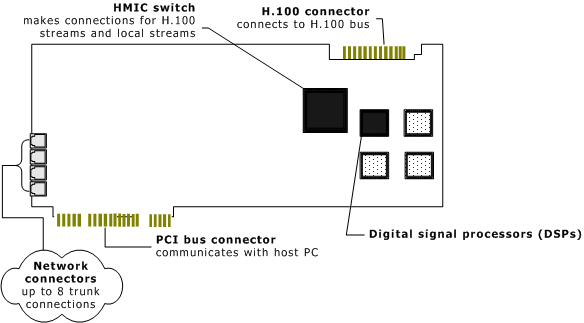
The following illustration shows where various components are located on an AG 2000 board: