In addition to the approval obtained by NMS for the board and its associated software, some countries require a system level approval before connecting the system to the public network. To learn what approvals you require, contact the appropriate regulatory authority in the target country.
This topic describes the following compliance and regulatory information:
|
US |
FCC Part 15, Subpart J
|
|
Canada |
IECS- 003
|
|
EU countries |
EN55022 1994 + Amendment 1
|
|
Australia |
AS/NZS 3548 |
|
Other countries |
Refer to www.dialogic.com |
|
US |
NRTL recognized to UL 1950, 3rd edition |
|
Canada |
NRTL recognized to CSA C22. 2 No. 950 |
|
EU countries |
EN60950 (1992) + Amendments 1 to 4 |
|
Australia |
ACA TS001 (1997) |
|
Other countries |
Refer to www.dialogic.com |
|
US |
FCC Part 68 |
|
|
Canada |
ISC CS-03 |
|
|
EU countries |
4 and 8 loop start interfaces |
Approved under R&TTE. |
|
|
4 loop start interfaces/4 NMS Fusion ports |
Approved under R&TTE. |
|
|
4 loop start/4 subscriber loop interfaces |
TBR 21 approved. |
|
Australia |
TS002 (1997), TS004 (1997) |
|
|
Japan |
JATE blue book |
|
|
Other countries |
Refer to www.dialogic.com |
|
For more detail about the information contained in the previous table, refer to the following board-specific information:
|
Board type |
Description |
|---|---|
|
Loop start |
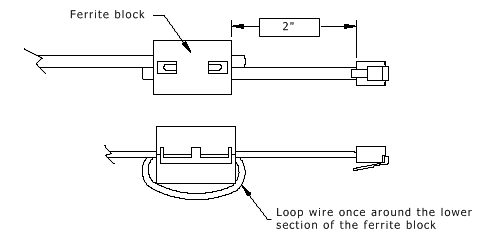
To satisfy the R&TTE regulatory requirements, you must ship, with each of your products, section 2 of the AG 2000 Loop Start and QX 2000 Loop Start Board Compliance Statements sheet that was delivered with your AG 2000 board. In Germany, Greece, and Portugal, your application must be designed so that the AG 2000 board seizes the phone line only with the intention to make a call. Except for EU countries where a line splitter cable is used, the loop start interface can be upgraded from Class A to Class B by installing the loop start class B upgrade (shown in the following illustration) on a standard telephone cable. |
|
Subscriber loop |
This is a Class A product. In a domestic environment, this product may cause radio interference. You may be required to take adequate measures. This board type is not intended to be connected to networks within the European Union. |
|
DID |
DID is not compatible with EU service. This board type is not intended to be connected to the public telecommunication networks within the European Union. |
|
Loop start and subscriber loop |
This is a Class A product. In a domestic environment, this product may cause radio interference. You may be required to take adequate measures. Each of the 4 loop start interfaces comply with TBR-21. Check with your regulatory approval authorities for obtaining approval requirements and Type approval of the system that you are building around this NMS board. This board type is not intended to be connected to public telecommunication networks within the European Union. |
This equipment has been approved in accordance with Council Decision 1999/ 5/ EC (R&TTE) for pan- European single terminal connection to the public switched telephone network (PSTN). However, due to differences between the individual PSTNs provided in different countries, the approval does not, of itself, give an unconditional assurance of successful operation on every PSTN network termination point. In the event of problems, contact your equipment supplier in the first instance.
Connect the AG 2000 board to the following public telecommunication networks:
|
d - Austria |
p - Germany |
d - Netherlands |
d - Switzerland |
|
d - Belgium |
d - Greece |
d - Norway |
d - Rep of Ireland |
|
p - Denmark |
p - Iceland |
d - Portugal |
p - UK |
|
p - France |
p - Italy |
p - Spain |
|
|
p - Finland |
d - Luxemburg |
p - Sweden |
|
d - Networks which are supported by DTMF signaling only for direct attachment.
p - Networks which are supported by DTMF signaling and pulse dialing for direct attachment.
To comply with the above networks, a software setting is necessary. Load the associated software and follow the instructions for your country.
Before connecting this board to a telecommunication loop start network, refer to the AG 2000 Loop Start Board Compliance Statements document for information on the current approvals obtained.
For certain countries, your application must include the control of the calls internally generated by the equipment. Failure to implement this regulatory requirement will void the regulatory approval granted to NMS for this NMS equipment.
|
Country |
Notes |
Maximum number of call attempts |
Minimum interval (seconds) between numbers |
Minimum interval (mn) to wait for a new series |
|---|---|---|---|---|
|
European countries |
|
15 |
5 |
- |
|
Australia |
For equipment with a service tone detector, a maximum number of 10 is allowed |
3 |
- |
30 |
|
Bulgaria |
|
12 |
2 |
60 |
|
Czech Republic |
|
12 |
5, then 60 |
- |
|
Israel |
|
15 |
30 |
- |
|
Japan |
There is a choice between the two requirements. |
3 in 3 mn 15 |
- 5 |
3 - |
|
Korea |
|
3 |
30 |
- |
|
Malaysia |
|
2 |
120 |
- |
|
New Zealand |
Not more than five call attempts to the same number within a 60 mn period with a minimum of 60 seconds between attempts, and a total of 10 call attempts to the same number. |
5 |
60 |
- |
|
Singapore |
|
10 |
60 |
- |
|
Slovakia |
|
12 |
60 |
- |
|
South Africa |
|
0 |
60 |
- |
|
Taiwan |
|
2 |
60 |
- |
Note: The call attempt series parameters apply to the equipment without distinction between a wrong number and an ineffective call. Maximum intervals between numbers is 12 mn.