The ADI service is capable of running an energy detector that examines the in-band signal and reports energy and silence transitions.
Note: Do not use the energy detector if you are using voice activity detection.
This topic presents:
adiStartEnergyDetector takes the following qualification time parameters:
|
Parameter |
Description |
|---|---|
|
energyqual |
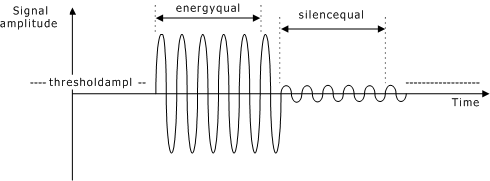
Energy qualification time; the time, in milliseconds, that energy must be present to report an energy event. |
|
silencequal |
Silence qualification time; the time, in milliseconds, that energy must be absent to report a silence event. |
You can modify the energy detector's default behavior by specifying the following parameters (stored in ADI_ENERGY_PARMS) when invoking adiStartEnergyDetector:
|
Parameter |
Description |
|---|---|
|
thresholdampl |
Threshold amplitude; the noise level, in dBm, below which is considered silence. Noise above this level is further qualified as energy. |
|
deglitch |
Deglitch time; the minimum time, in milliseconds, before a transition between energy and silence is recognized. |
|
autostop |
Automatic stop; controls whether the energy detector continues running after the first event. By default, automatic stop is enabled. |
The following illustration shows the energy detection parameters:
The energy detector generates the following events:
ADIEVN_SILENCE_DETECTED
ADIEVN_ENERGY_DETECTED
ADIEVN_ENERGY_DETECT_DONE
adiStopEnergyDetector immediately terminates energy and silence detection. The ADI service generates ADIEVN_ENERGYDETECT_DONE with the value set to CTA_REASON_STOPPED, which means that the operation was stopped by application request.
The ADI service also generates ADIEVN_ENERGYDETECT_DONE, and ADIERR_xxx, CTAERR_xxx, or CTA_REASON_FINISHED. When set to autostop (one-shot), the value is set to CTA_REASON_FINISHED and the size field contains either ADIEVN_ENERGY_DETECTED or ADIEVN_SILENCE_DETECTED.