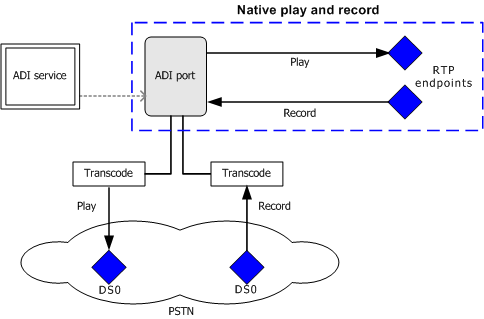
NMS native play and record enables applications to maintain the quality of audio data played and recorded over network interfaces while minimizing the encoding and decoding resources needed to process the audio data.
Applications can perform the following tasks with NMS native play and record:
Record voice data from RTP data streams transferred through MSPP service endpoints.
Play and record media streams that contain silence, SID frames, RFC 2833 markers, and lost frame markers.
Perform silence and DTMF detection while recording RTP streams.
Play media recorded directly from RTP streams to PSTN (DS0) ports without changing the native format of the data.
CG boards support NMS native play and record functionality.
When an application plays or records audio data over an IP network, typically the application must encode or decode the data. Audio data is often encoded in a compressed format such as G.711 or G.723.1. Encoding or decoding the audio stream can consume system resources and incrementally degrade the quality of the data.
When an application records audio data using native record, the audio is stored in the NMS EDTX (extended discontinuous transmission) format without encoding the data. The application can then either play back the audio data directly to a network interface or transfer the data to the PSTN interface through a decoder.
The following illustration shows the advantages of native play and record:
NMS native play and record uses an NMS proprietary format called EDTX (extended discontinuous transmission) to store and play back codec frames. EDTX formatting incorporates an optional silence compression scheme that uses silence frames in the recorded stream to indicate periods of silence.
Native play and record supports the following encoding types:
AMR (CG boards only)
G.711A, G.711U
G.723.1
G.726
G.729A/B
EVRC
For more information about supported vocoder types, refer to the Fusion vocoder readme.txt files.
Applications can implement native play and record in the following ways:
|
Implementation |
Description |
|
Application plays a stream of audio data from an ADI port to an RTP endpoint. |
|
|
Application receives and records a stream of audio data from an RTP endpoint. No data decoding takes place, inband silence detection is not supported, and DTMF detection is supported only through Fusion RFC 2833 support. |
|
|
Application receives and records a stream of audio data from an RTP endpoint, and in parallel, decodes the data from its network format (for example, G.711A or G.723.1). The application also performs silence detection, DTMF detection, or both with the data. |
To implement native play functionality, the application performs the following tasks:
Opens the ADI service on the context and starts the nocc protocol.
Opens the MSPP service on the context and creates an RTP endpoint.
Retrieves the filter ID of the RTP endpoint.
Supplies the ADI service with information about the RTP audio streams and specifies the desired behavior for native play operations.
Starts and stops playing audio data from a native audio stream.
The following illustration shows an overview of the native play mechanism:

When implementing native play functionality, applications use functions from the following resources:
Natural Access functions to set up event queues and contexts, and to open services on the contexts.
ADI service functions to start a protocol, set native play settings, and play out audio data.
MSPP functions to create an RTP endpoint and retrieve the unique filter ID for the endpoint.
The following procedure shows functions used to implement a typical native play operation:
|
Step |
Action |
|
1 |
Invoke ctaCreateQueue to create a Natural Access event queue. ctaCreateQueue (&queuehd) |
|
2 |
Invoke ctaCreateContext to create a Natural Access context for the audio channel. ctaCreateContext (queuehd, &ctahd) |
|
3 |
Invoke ctaOpenServices to open the ADI and MSPP services on the context. ctaOpenServices (ctahd, svclist, nsvcs) |
|
4 |
Invoke adiStartProtocol to start the nocc protocol on the ADI port. adiStartProtocol (ctahd, "nocc", NULL, startparms) |
|
5 |
Invoke mspCreateEndpoint to create an audio MSPP service RTP endpoint. mspCreateEndpoint returns an MSPP service endpoint handle (ephd). mspCreateEndpoint (ctahd, mspaddrstruct, mspparmstruct, &rtpephd) |
|
6 |
Invoke mspGetFilterHandle to retrieve the runtime filter ID (fltID) associated with the RTP endpoint handle (ephd). The application uses the returned fltID as the destination for the audio stream played out from the ADI port. mspGetFilterHandle (rtpephd, MSP_ENDPOINT_RTPFDX, &fltID) |
|
7 |
Invoke adiSetNativeInfo to set NMS native play parameters, specifying both the context handle of the ADI port and the RTP endpoint fltID returned by mspGetFilterHandle. adiSetNativeInfo (ctahd, NULL, fltID, fltID_parms) |
|
8 |
Invoke adiPlayFromMemory to begin playing a message. adiPlayFromMemory (ctahd, encoding, buffer, bufsize, parms) |
|
9 |
Invoke adiStopPlaying to stop playing the message. adiStopPlaying (ctahd) |
The following example shows how to perform a native play operation:
ret = ctaCreateQueue( NULL, 0, &hCtaQueueHd );
ret = ctaCreateContext( hCtaQueueHd, 0, "Play", &ctahd );
ServiceCount = 2;
ServDesc[0].name.svcname = "ADI";
ServDesc[0].name.svcmgrname = "ADIMGR";
ServDesc[0].mvipaddr.board = board;
ServDesc[0].mvipaddr.mode = 0;
ServDesc[1].name.svcname = "MSP";
ServDesc[1].name.svcmgrname = "MSPMGR";
ret = ctaOpenServices( ctahd, ServDesc, ServiceCount );
ret = WaitForSpecificEvent( CTAEVN_OPEN_SERVICES_DONE, &event );
ret = adiStartProtocol( ctahd, "nocc", NULL, NULL );
ret = WaitForSpecificEvent( ADIEVN_STARTPROTOCOL_DONE, &event );
// create mspp RTP endpoint
ret = mspCreateEndpoint( ctahd, &mspAddr, &mspParm, &ephd );
ret = WaitForSpecificEvent( MSPEVN_CREATE_ENDPOINT_DONE, &event );
// get cg6xxx board handle
ret = mspGetFilterHandle( msphd, MSP_FILTER_RTPFDX_EPH, rtp_play_filter_handle );
ret = adiSetNativeInfo( ctahd, NULL, /* no ingress handle, as this is a play only */
rtp_play_filter_handle, &natpr_ctl ); /* RTP endpoint filter ID
specified as a destination for audio */
ret = adiPlayFromMemory( ctahd, ADI_ENCODE_EDTX_AMRNB, /* audio play */
MemoryBuffer, RecordedBytes, NULL );
.
.
.
ret = adiStopPlaying ( ctahd );
To implement native record functionality without inband silence detection or DTMF detection, the application performs the following tasks:
Creates a Natural Access event queue and context.
Opens the ADI and MSPP services on the context and starts the nocc protocol on the context.
Creates an MSPP RTP endpoint and an MSPP record channel on the context.
Connects the RTP endpoint with the record channel to create a record connection.
Retrieves the filter ID of the jitter filter within the record channel.
Supplies the ADI service with information about the RTP audio streams and specifies the desired behavior for native record operations.
Starts and stops recording audio data from a network audio stream.
Note: Applications can perform DTMF detection using Fusion RFC 2833 support, but silence detection is not supported. Refer to the Dialogic® NaturalAccess™ Fusion™ VoIP API Developer’s Manual for more information.
The following illustration shows an overview of the native record mechanism without voice decoding:

Applications use functions from the following Natural Access resources to implement native record functionality without inband silence detection or DTMF detection:
Natural Access functions to set up event queues and contexts, and to open services on the contexts.
ADI service functions to start a protocol, set native record settings, and record incoming audio data.
MSPP functions to create a voice connection consisting of a record channel and an RTP endpoint, and to retrieve the unique filter ID associated with the record channel.
The following procedure shows functions used to implement a typical native record operation without decoding:
|
Step |
Action |
|
1 |
Invoke ctaCreateQueue to create a Natural Access event queue. ctaCreateQueue (&queuehd) |
|
2 |
Invoke ctaCreateContext to create a Natural Access context for the audio channel. ctaCreateContext (queuehd, &ctahd) |
|
3 |
Invoke ctaOpenServices to open the ADI and MSPP services on the context. ctaOpenServices (ctahd, svclist, nsvcs) |
|
4 |
Invoke mspCreateEndpoint to create an audio RTP endpoint. mspCreateEndpoint returns an endpoint handle (ephd). mspCreateEndpoint (ctahd, mspaddrstruct, mspparmstruct, &rtpephd) |
|
5 |
Invoke mspCreateChannel to create a record channel. mspCreateChannel (ctahd, chnladdr, chnlparms, &chanhd) |
|
6 |
Invoke mspConnect to connect the record channel with the RTP endpoint. Specify MSP_NO_CONNECT instead of a DS0 endpoint handle. mspConnect (MSP_NO_CONNECT, chanhd, rtpephd) |
|
7 |
Invoke mspEnableChannel to enable the record channel to process data. mspEnableChannel (msphd) |
|
8 |
Invoke adiStartProtocol to start the nocc protocol on the audio channel. adiStartProtocol (ctahd, "nocc", NULL, startparms) |
|
9 |
Invoke mspGetFilterHandle to retrieve the filter identifier (fltID) associated with the MSPP record channel. mspGetFilterHandle (chanhd, MSP_FILTER_JITTER, &fltID) |
|
10 |
Invoke adiSetNativeInfo to set NMS native record parameters. Specify both the context handle of the ADI port and the fltID returned by mspGetFilterHandle. adiSetNativeInfo (ctahd, fltID, NULL, natpr_parms) |
|
11 |
Invoke ctaGetParms to return parameter values for the ADI_RECORD_PARMS structure. ctaGetParms(ctahd, parmid, buffer, size) |
|
12 |
Invoke adiRecordToMemory to begin recording audio data. adiRecordToMemory (ctahd, buf, bufsize, rec_param) |
|
13 |
Invoke adiStopRecording stop recording audio data. adiStopRecording (ctahd) |
The following example shows how to perform a native record operation without decoding:
ret = ctaCreateQueue( NULL, 0, &hCtaQueueHd ) ;
ret = ctaCreateContext( hCtaQueueHd, 0, "Record", &ctahd );
ServiceCount = 2;
ServDesc[0].name.svcname = "ADI";
ServDesc[0].name.svcmgrname = "ADIMGR";
ServDesc[0].mvipaddr.mode = ADI_VOICE_DUPLEX;
ServDesc[0].mvipaddr.stream = 0;
ServDesc[0].mvipaddr.timeslot = record_timeslot;
ServDesc[1].name.svcname = "MSP";
ServDesc[1].name.svcmgrname = "MSPMGR";
ret = ctaOpenServices( ctahd, ServDesc, ServiceCount );
ret = WaitForSpecificEvent( CTAEVN_OPEN_SERVICES_DONE, &Event );
// IP Channel Initialization
MSPHD ds0_ephd = MSP_NO_CONNECT;
MSPHD rtp_ephd;
// Create and init RTP endpoint
&
mspCreateEndpoint( ctaHd, &rtpaddr, &rtp_params, rtp_ephd );
if (! WaitForSpecificEvent(MSPEVN_CREATE_ENDPOINT_DONE, &Event, 5000))
{
printf("Failed waiting for MSPEVN_CREATE_ENDPOINT_DONE (RTP)");
return FAILURE;
}
chanaddr.nBoard = Board;
chanaddr.channelType = G711RecordChannel;
chanaddr.FilterAttribs = MSP_FCN_ATTRIB_RFC2833;
chan_params.size = sizeof( MSP_CHANNEL_PARAMETER );
chan_params.channelType = G711RecordChannel;
chan_params.ChannelParms.VoiceParms.size = sizeof( MSP_VOICE_CHANNEL_PARMS );
// Create channel
mspCreateChannel( ctaHd, &chanaddr, &chan_params, &msphd );
CTA_EVENT CtaEvent;
if (! WaitForSpecificEvent(MSPEVN_CREATE_CHANNEL_DONE, &Event, 5000))
{
printf("Failed waiting for MSPEVN_CREATE_CHANNEL_DONE");
return FAILURE;
}
// connect mspp endpoints
ret = mspConnect( ds0_ephd, msphd, rtp_ephd );
if (! WaitForSpecificEvent(MSPEVN_CONNECT_DONE, &Event, 5000))
{
printf("Failed waiting for MSPEVN_CONNECT_DONE");
return FAILURE;
}
// connect mspp enable channel
mspEnableChannel( msphd );
if (! WaitForSpecificEvent(MSPEVN_ENABLE_CHANNEL_DONE, &Event, 5000))
{
printf("Failed waiting for MSPEVN_ENABLE_CHANNEL_DONE");
return FAILURE;
}
//adiStartProtocol
adiStartProtocol( ctahd, "nocc", NULL, NULL );
if (! WaitForSpecificEvent (ADIEVN_STARTPROTOCOL_DONE, &Event, 5000))
{
printf("Failed to receive ADIEVN_STARTPROTOCOL_DONE event");
return FAILURE;
}
// get cg6xxx board handle
ret = mspGetFilterHandle( msphd, MSP_FILTER_JITTER, &cg6xxx_board_filter_handle );
ADI_NATIVE_CONTROL parms = {0}; /* Native parameters */
parms.frameFormat = 0;
parms.include2833 = 0;
parms.vadFlag = 0;
parms.nsPayload = 0;
parms.mode = ADI_NATIVE;
parms.rec_encoding = ADI_ENCODE_EDTX_MU_LAW;
parms.payloadID = 0;
ret = adiSetNativeInfo( ctahd, cg6xxx_board_filter_handle,
NULL, /* this is record only so no egress handle */
&parms);
// get default adi record parms
ret = ctaGetParms( ctahd, ADI_RECORD_PARMID, &recparms, sizeof(ADI_RECORD_PARMS) );
ret = adiRecordToMemory( ctahd, ADI_ENCODE_EDTX_MU_LAW, /* audio rec */
MemoryBuffer, RecordedBytes, &recparms );
.
.
.
adiStopRecording ( ctahd );
On CG boards, use the following procedure to implement native record with inband silence detection or DTMF detection.
To implement native record functionality with inband silence detection or DTMF detection, the application performs the following tasks:
Opens the ADI service on a Natural Access context and starts the nocc protocol on the context.
Opens the MSPP service and the ADI service on a second context, and creates an RTP endpoint, a DS0 endpoint, and a voice channel on the context.
Connects the RTP endpoint, DS0 endpoint, and voice channel to create a voice connection.
Creates a switch connection between the ADI port and the DS0 endpoint.
Retrieves the filter ID of the jitter filter associated with the voice channel.
Supplies the ADI service with information about the RTP audio streams and specifies the desired behavior for native record operations.
Starts and stops recording audio data from a network audio stream.
The following illustration shows an overview of the native record mechanism with voice decoding enabled:
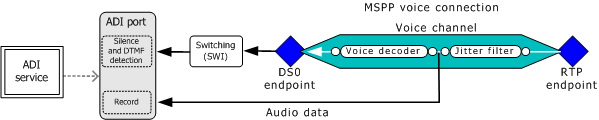
Applications use functions from the following Natural Access resources to implement native record functionality with inband silence detection or DTMF detection:
Natural Access functions to set up event queues and contexts and to open services on the contexts.
ADI service functions to start a protocol, set native record settings, and record incoming audio data.
MSPP functions to create a voice connection consisting of a voice decoding channel, an RTP endpoint, and a DS0 endpoint, and to retrieve the unique filter ID of the RTP endpoint's jitter filter.
SWI functions to switch together the ADI service port and the MSPP service connection (through the DS0 endpoint).
The following procedure shows functions used to implement a typical native record operation with decoding on CG boards:
|
Step |
Action |
|
1 |
Invoke ctaCreateQueue to create a Natural Access event queue. ctaCreateQueue (&queuehd) |
|
2 |
Invoke ctaCreateContext to create a Natural Access context for the audio channel. ctaCreateContext (queuehd, &ctahd) |
|
3 |
Invoke ctaOpenServices to open the ADI service on the context. When using ctaOpenServices, the application must specify the following:
ctaOpenServices (ctahd, svclist, nsvcs) |
|
4 |
Invoke adiStartProtocol to start the nocc protocol on the audio channel and enable silence detection on the audio channel. adiStartProtocol (ctahd, "nocc") |
|
5 |
Invoke swiOpenSwitch to open a switching device for the context. swiOpenSwitch returns a switch handle (swihd). swiOpenSwitch (ctahd, "cg6ksw", board, 0x0, &swihd) |
|
6 |
Invoke ctaCreateContext to create a Natural Access context for the MSPP channel. ctaCreateContext (queuehd, &msphd) |
|
7 |
Invoke ctaOpenServices to open the MSPP service on the context. ctaOpenServices (msphd, svclist, nsvcs) |
|
8 |
Invoke mspCreateEndpoint to create an audio RTP endpoint. mspCreateEndpoint returns an endpoint handle (&rtpephd). mspCreateEndpoint (msphd, mspaddrstruct, mspparmstruct, &rtpephd) |
|
9 |
Invoke mspCreateEndpoint to create an audio DS0 endpoint. mspCreateEndpoint returns an endpoint handle (&ds0ephd). mspCreateEndpoint (msphd, mspaddrstruct, mspparmstruct, &ds0ephd) |
|
10 |
Invoke mspCreateChannel to create a full duplex or voice decoding channel. mspCreateChannel (msphd, chnladdr, chnlparms, &chanhd) |
|
11 |
Invoke mspConnect to connect the DS0 and RTP endpoints with the voice channel. mspConnect (ds0ephd, chanhd, rtpephd) |
|
12 |
Invoke mspEnableChannel to enable the record channel to process data. mspEnableChannel (msphd) |
|
13 |
Invoke swiMakeConnection with the swihd returned by swiOpenSwitch to connect the MSPP DS0 output to the ADI audio channel input and vice versa. When using swiMakeConnection, the application specifies the stream and timeslot used to create the ADI port and the stream and timeslot used to create the DS0 endpoint. swiMakeConnection (swihd, adi_ds0, ds0ephd, 2) |
|
14 |
Invoke mspGetFilterHandle to retrieve the filter identifier (fltID) associated with the MSPP record channel. mspGetFilterHandle (chanhd, MSP_FILTER_JITTER, &fltID) |
|
15 |
Invoke adiSetNativeInfo to set NMS native record parameters. Specify both the context handle of the ADI port and the fltID returned by mspGetFilterHandle. adiSetNativeInfo (ctahd, fltID, NULL, natpr_parms) |
|
16 |
Invoke ctaGetParms to return parameter values for the ADI_RECORD_PARMS structure. ctaGetParms(ctahd, parmid, buffer, size) |
|
17 |
Invoke adiRecordToMemory to begin recording a message. adiRecordToMemory (ctahd, buf, bufsize, rec_param) |
|
18 |
Invoke adiStopRecording stop recording the audio portion of the message. adiStopRecording (ctahd) |
The following example shows how to perform a native record operation that supports ADI silence and DTMF detection on CG boards:
ret = ctaCreateQueue( NULL, 0, &hCtaQueueHd );
// create context for ADI port
ret = ctaCreateContext( hCtaQueueHd, 0, "Record", &ctahd );
ServiceCount = 1;
ServDesc[0].name.svcname = "ADI";
ServDesc[0].name.svcmgrname = "ADIMGR";
ServDesc[0].mvipaddr.mode = ADI_VOICE_DUPLEX;
ServDesc[0].mvipaddr.stream = 0;
ServDesc[0].mvipaddr.timeslot = record_timeslot;
ret = ctaOpenServices( ctahd, ServDesc, ServiceCount );
ret = WaitForSpecificEvent( CTAEVN_OPEN_SERVICES_DONE, &Event );
{
printf("Failed to receive CTAEVN_OPEN_SERVICES_DONE event");
return FAILURE;
}
//adiStartProtocol
adiStartProtocol( ctahd, "nocc", NULL, NULL );
if (! WaitForSpecificEvent (ADIEVN_STARTPROTOCOL_DONE, &Event, 5000))
{
printf("Failed to receive ADIEVN_STARTPROTOCOL_DONE event");
return FAILURE;
}
ret = swiOpenSwitch(ctahd, "agsw", Board, 0, &swihd);
if (ret != SUCCESS)
{
printf("Makeconnections: Failed to open board %d\n",Board);
return FAILURE;
}
// create context for MSPP channel
ret = ctaCreateContext( hCtaQueueHd, 0, "MSPP", &ipHd );
ServiceCount = 2;
ServDesc[0].name.svcname = "ADI";
ServDesc[0].name.svcmgrname = "ADIMGR";
ServDesc[0].mvipaddr.mode = ADI_VOICE_DUPLEX;
ServDesc[0].mvipaddr.stream = 0;
ServDesc[0].mvipaddr.timeslot = fusion_timeslot;
ServDesc[1].name.svcname = "MSP";
ServDesc[1].name.svcmgrname = "MSPMGR";
ret = ctaOpenServices( iphd, ServDesc, ServiceCount );
ret = WaitForSpecificEvent( CTAEVN_OPEN_SERVICES_DONE, &Event );
{
printf("Failed to receive CTAEVN_OPEN_SERVICES_DONE event");
return FAILURE;
}
// IP Channel Initialization
MSPHD ds0_ephd;
MSPHD rtp_ephd;
// Create and init RTP endpoint
MSP_ENDPOINT_ADDR rtpaddr = {0};
MSP_ENDPOINT_PARAMETER rtp_params = {0};
rtpaddr.size = sizeof(MSP_ENDPOINT_ADDR);
rtpaddr.eEpType = MSP_ENDPOINT_RTPFDX;
rtpaddr.nBoard = Board;
...
mspCreateEndpoint( ipHd, &rtpaddr, &rtp_params, &rtp_ephd );
if (! WaitForSpecificEvent(MSPEVN_CREATE_ENDPOINT_DONE, &Event, 5000))
{
printf("Failed waiting for MSPEVN_CREATE_ENDPOINT_DONE (RTP)");
return FAILURE;
}
// create mspp DS0 endpoint
MSP_ENDPOINT_ADDR ds0addr = {0};
ds0addr.eEpType = MSP_ENDPOINT_DS0;
ds0addr.nBoard = Board;
ds0addr.size = sizeof(MSP_ENDPOINT_DS0);
ds0addr.EP.DS0.nTimeslot = fusion_timeslot;
MSP_ENDPOINT_PARAMETER ds0parms = {0};
ds0parms.size = sizeof(DS0_ENDPOINT_PARMS);
ds0parms.eParmType = MSP_ENDPOINT_DS0;
ds0parms.EP.DS0.media = MSP_VOICE;
mspCreateEndpoint( ipHd, &ds0addr, &ds0parms, &ds0_ephd );
if (! WaitForSpecificEvent(MSPEVN_CREATE_ENDPOINT_DONE, &Event, 5000))
{
printf("Failed waiting for MSPEVN_CREATE_ENDPOINT_DONE (DS0)");
return FAILURE;
}
// create mspp Channel
MSP_CHANNEL_ADDR chanaddr = {0};
MSP_CHANNEL_PARAMETER chan_params = {0};
chanaddr.nBoard = Board;
chanaddr.channelType = G711FullDuplex;
chanaddr.FilterAttribs = MSP_FCN_ATTRIB_RFC2833;
chan_params.size = sizeof( MSP_CHANNEL_PARAMETER );
chan_params.channelType = G711FullDuplex;
chan_params.ChannelParms.VoiceParms.size = sizeof( MSP_VOICE_CHANNEL_PARMS );
...
// Create channel
mspCreateChannel( ipHd, &chanaddr, &chan_params, &msphd );
CTA_EVENT CtaEvent;
if (! WaitForSpecificEvent(MSPEVN_CREATE_CHANNEL_DONE, &Event, 5000))
{
printf("Failed waiting for MSPEVN_CREATE_CHANNEL_DONE");
return FAILURE;
}
// connect mspp endpoints
ret = mspConnect(ds0_ephd , msphd, rtp_ephd);
if (! WaitForSpecificEvent(MSPEVN_CONNECT_DONE, &Event, 5000))
{
printf("Failed waiting for MSPEVN_CONNECT_DONE");
return FAILURE;
}
// connect mspp enable channel
mspEnableChannel(msphd);
if (! WaitForSpecificEvent(MSPEVN_ENABLE_CHANNEL_DONE, &Event, 5000))
{
printf("Failed waiting for MSPEVN_ENABLE_CHANNEL_DONE");
return FAILURE;
}
// connect Fusion and ADI timeslots to allow Silence and DTMF detection
SWI_TERMINUS input[2];
SWI_TERMINUS output[2];
output[0].bus = MVIP95_LOCAL_BUS;
output[0].stream = BoardStream;
output[0].timeslot = record_timeslot;
output[1].bus = MVIP95_LOCAL_BUS;
output[1].stream = BoardStream;
output[1].timeslot = fusion_timeslot;
input[0].bus = MVIP95_MVIP_BUS;
input[0].stream = BoardStream+1;
input[0].timeslot = fusion_timeslot;
input[1].bus = MVIP95_MVIP_BUS;
input[1].stream = BoardStream+1;
input[1].timeslot = record_timeslot;
swiMakeConnection (swihd, input, output, 2)
// get cg6xxx board handle
ret = mspGetFilterHandle( msphd, MSP_FILTER_JITTER, &cg6xxx_board_filter_handle );
ADI_NATIVE_CONTROL parms = {0}; /* Native parameters */
parms.frameFormat = 0;
parms.include2833 = 0;
parms.vadFlag = 0;
parms.nsPayload = 0;
parms.mode = ADI_NATIVE;
parms.rec_encoding = ADI_ENCODE_EDTX_MU_LAW;
parms.payloadID = 0;
ret = adiSetNativeInfo( ctahd, cg6xxx_board_filter_handle,
NULL, /* this is record only so no egress handle */
&parms );
// get default adi record parms
ret = ctaGetParms( ctahd, ADI_RECORD_PARMID, &recparms, sizeof(ADI_RECORD_PARMS) );
ret = adiRecordToMemory( ctahd, ADI_ENCODE_EDTX_MU_LAW, /* audio rec */
MemoryBuffer, RecordedBytes, &recparms );
.
.
.
adiStopRecording (ctahd);