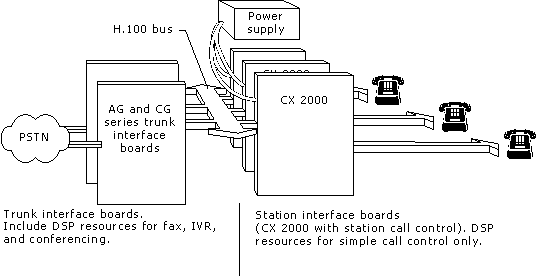
CX 2000 boards are station interfaces for Enterprise markets. They provide analog interfaces to analog devices such as telephones, fax machines, and modems within a private network. They can be used to build such systems as private branch exchanges, automatic call distributors, and IP-PBXs.
In a system containing CX 2000 boards, any communication with the public network is performed by trunk interface boards. CX 2000 boards communicate with these boards over the H.100 bus.
Refer to www.dialogic.com/declarations/default.htm for a list of available CX 2000 board configurations, for a list of countries where Dialogic has obtained approval for the CX 2000 board, and for product updates.
CX 2000 boards have sufficient on-board DSP resources for simple, low-level call control functions. More complex, resource-intensive operations (such as voice play or record functions) must be performed by other boards.
The CX 2000-32 board supports up to 32 stations and provides high ring capacity. It has the following limitations:
Requires external ring voltage supply
Requires a chassis with air flow considerations described in Selecting a PCI chassis
UL and CSA requirements limit cabling to within the building
CX 2000 boards offer a standard set of station call control features. Functions such as playing, recording, and conferencing are performed by the trunk interface boards or other resource boards in the system.
The following table summarizes the CX 2000 board features:
|
Chassis type |
PCI |
|
Number of ports |
32 |
|
CT bus |
H.100 |
|
Call center applications |
Supported |
|
PBX applications |
Supported |
|
Detect on/off hook |
Supported |
|
Detect flash-hook |
Supported |
|
DTMF detection |
Supported |
|
DTMF generation |
Supported |
|
Dial tone |
Supported |
|
Call progress tones |
Supported |
|
CT bus switching API |
Supported |
|
Heart beat diagnostic |
Supported |
|
Transmit gain |
Supported |
|
Receive gain |
Supported |
|
Temperature sensors |
Supported |
|
On premise extensions |
Supported |
|
Off premise extensions |
Not supported |
|
Wiring between buildings |
Not supported The CX 2000 board is limited to inside cabling, due to both heat and safety power cross certification. |
|
Internal ringing supply |
Not supported |
|
Easy chassis selection |
Not supported Selecting a PCI chassis with proper air flow is critical for multiple CX 2000-32 boards to operate. For more information, refer to Selecting a PCI chassis. |
The CX 2000 fully supports the H.100 bus specification. Switching is implemented with the T8100A chip. The T8100A offers full support for the H.100 bus within the H.100 architecture providing access to all 4096 slots on the bus.
On the boards, switch connections are allowed for up to 128 full duplex connections between local devices and the bus. Non-blocking switch connections are allowed between local devices.
To provide power for talk battery and for ringing station telephones (if necessary), an external power supply is required. NMS Communications supplies a rack mount power supply chassis that can contain up to four interchangeable supply modules. Alternatively, you can obtain a power supply from another source. You can connect the power supply to each board.
For more information on choosing and connecting power supplies, refer to Using the NMS rack mount power supply chassis.
To make connecting telephones to CX 2000 boards easier, a developer's cable kit is available. It consists of the following components:
Two RJ-21, twenty-five pair, 10 feet cables
Two breakout boxes RJ-21 to 25 RJ-11
For more information about the developer's cable kit, refer to Connecting to station telephones.