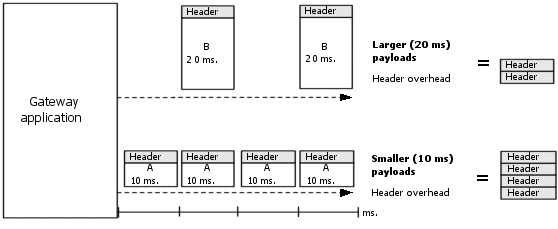
One way to decrease audio latency between the speaker and the listener in packet-based voice transmissions is to send smaller payloads of voice data. This reduces audible delay, but increases the number of packets that need to be transferred for a given voice data transmission. Since each of these smaller audio payloads requires a set amount of header information, the overall effect is to increase the total amount of data that the gateway must transmit.
Typically, voice data is transmitted over a packet-switched network like the Internet in a continuous stream of discrete RTP data packets transferred on a per-channel basis. The header portion of the packet represents overhead associated with the actual voice data. For information transmitted across IP connections, the packet header includes a link header, an IP header, a UDP header, and an RTP header. This overhead is fixed in size, even if the packet payload size decreases.
As gateways systems reduce packet payload size in an effort to decrease per-session latency, packet headers represent an increasing percentage of the total packet size. Transmitting smaller packets also means transmitting more packets (and therefore a greater number of headers) in order to transfer the same amount of data. An increase in the number of packets that gateways transmit can also impose a cumulative increase in the workload for network routers and, overall, contribute to a reduction of quality in network transmissions.
The following illustration shows how the proportion of network bandwidth used to transmit packet headers (or overhead) increases as the size of packet payloads decreases:
Note: Fusion does not support IPv6 for ThroughPacket fax connections.