RFC 2833 (RTP Payloads for DTMF Digits, Telephony Tones, and Telephony Signals) specifies an RTP payload format for carrying dual-tone multi frequency (DTMF) digits, and other line and trunk signals. Fusion channels that support RFC 2833 provide the following features:
Detect the presence of DTMF digits in voice data received from PSTNs and pass this information via RFC 2833 compliant RTP packets for the duration of the DTMF digit.
Send RFC 2833 packets for a specified duration. RFC 2833 specifies a packet format for DTMF digits, line events, and trunk events.
Detect incoming RFC 2833 RTP packets, and send notifications to the host. RFC 2833 RTP packets that contain DTMF information are passed down the filter chain to be played out to the PSTN interface.
Fusion supports transferring DTMF digits according to RFC 2833 in both RTP IPv4 and RTP IPv6 endpoints.
RFC 2833 specifies a payload format for carrying DTMF signaling information within RTP packets. Complying with the RFC 2833 standard provides the following advantages:
Reduces the risk of low bit-rate vocoders such as G.723.1 rendering DTMF tones unintelligible to receiving gateways.
Makes it unnecessary for VoIP gateways to perform DTMF detection on incoming voice streams. Instead, applications can detect DTMF tones by waiting for specially formatted inband DTMF packets.
Fusion implements the RFC 2833 specification by enabling MSPP voice channels to detect DTMF digits in voice data received from PSTNs (that is, through DS0 endpoints). Voice channels then package the DTMF tone information into specially formatted RTP packets before transferring them to a packet network. These inband DTMF packets do not contain any voice data. The payload contained in each packet payload only contains information about the type of tone detected, the tone's gain, and the tone's duration.
In a gateway that receives the RFC 2833 compliant inband DTMF packet, the MSPP voice channels detect the packets. When the voice channel on the receiving gateway application receives the RFC 2833 compliant payload, it sends the application an event indicating the digit received and generates an appropriate tone based on the information within the packet payload. For a description of MSPP unsolicited events associated with connections configured to support RFC 2833, refer to RFC 2833 related events.
The receiving gateway does not use other services (such as the ADI service) to detect DTMF digits in the incoming voice data stream received from the packet network, or to generate DTMF tones for data directed to the PSTN.
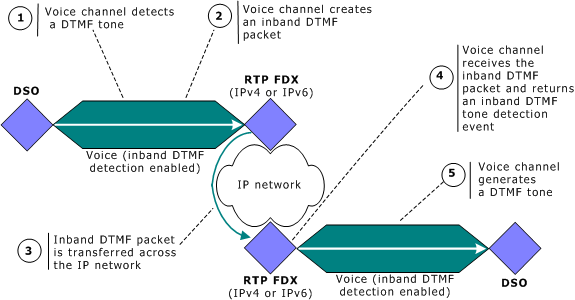
The Fusion inband DTMF mechanism method works in the following way:
|
Step |
Action |
|
1 |
The MSPP voice channel on the Fusion gateway receives a DTMF tone through the PSTN. |
|
2 |
The channel generates RFC 2833 compliant inband DTMF packets for the detected tone until the tone ceases. |
|
3 |
The gateway continuously generates inband DTMF packets and transfers them to the IP network. |
|
4 |
When another Fusion gateway receives an RFC 2833 compliant inband DTMF packet (though an RTP IPv4 or IPv6 endpoint), the MSPP service reads the payload content. The MSPP service generates an unsolicited event that specifies the identity, gain, and duration of the received DTMF tone. |
|
5 |
The MSPP voice channel also generates the appropriate DTMF tone on the outgoing voice data stream. |
The following illustration shows how to implement inband DTMF carriage through RFC 2833 compliant packets: