This section provides an overview of the supplementary services available with the ETS 300 variant, and how these services operate in the network architecture. It describes:
ETS 300 specifications describe a protocol designed to access network services from an intelligent user terminal. The protocol is not symmetric. It requires two distinct roles, the user side and the network side. NMS ISDN supports both sides for basic call control. Supplementary services, at this time, are implemented only for the user side.
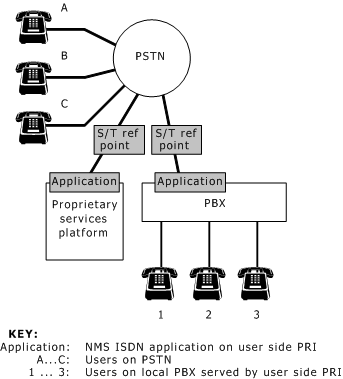
The following illustration shows a sample network and the points where an NMS ISDN ETS 300 supplementary service application can interface with the network. As shown in the illustration, an NMS ISDN application written for the ETS 300 variant interfaces with the network on the user side of the S/T reference point of a CEPT E1 PRI ISDN trunk.
Supplementary services over the T reference point are generally requests by the application for the network to perform an action on behalf of a subscriber or interface (for example, transfer a call).
Under ETS 300, most supplementary services require subscription. Subscription services are optional services provided by the network operator on a provisioning basis. When requesting network services from a provider, you can also request one or more subscription services. The services are not available unless the interface is provisioned with them.
Note: Some supplementary services may not require subscription. For example, the call hold service may be generally available.
Under ETS 300, most supplementary services must be activated before they are used. Activation is the process of turning on a service at the network or stack level. Once a service is activated, the network, the stack and/or the application can invoke (use) the service when needed.
A supplementary service can be activated in at least one of the following ways:
Some supplementary services are activated the moment they are subscribed to. The remind diversion service is one of these. To deactivate this service, the service provider must be contacted.
Other supplementary services are activated or deactivated by the application as necessary. The call diversion service is an example: the application can activate it to configure the network to automatically forward a user's calls.
Many supplementary services can be set up either way. For example, when subscribing to advice of charge (AOC) services, the user can specify that the service is active at all times. Alternatively, services can be configured so they are active only when the application requests an activation.
The act of using an activated supplementary service is called invocation of the service. In some cases, an application can automatically activate an inactive supplementary service by invoking it: the activation and invocation occur simultaneously. The explicit call transfer service is an example: the application can invoke this service on a call-by-call basis.
An application on the user side of the S/T reference point may invoke hold and retrieve services on the network. When a call (identified by its connection ID) is placed on hold, the bearer channel (B channel) resource for the call is deallocated without losing the context of the call. The network side of the S/T reference point then reserves the B channel for allocation in a subsequent call offered by the user side.
The following notify hold and notify retrieve operations can be performed under ETS 300:
|
Operation |
Usage |
|---|---|
|
Notify hold |
The network informs a party that it is on hold. |
|
Notify retrieve |
The network informs a held party that it has been retrieved. |
For more information, see Notify hold (ETS 300) and Notify retrieve (ETS 300).
Call transfer services allow an application at the user side of the S/T reference point to join two existing calls on the network side.
The following call transfer operations can be performed under ETS 300:
|
Operation |
Usage |
|---|---|
|
Invoke explicit call transfer |
An application sends a request to the network to join two existing calls. |
|
Notify transfer |
The network notifies the joined users when a call has been affected by a remote transfer. |
Under ETS 300, two types of call forwarding services are available: call diversion and call deflection.
Call diversion is activated by the served user application on the network for all calls for a specific user or trunk. With this service active, the network reroutes calls addressed to a specific user or trunk, without consulting the user side of the S/T reference point. Three types of call diversion are supported:
Call forwarding - unconditional
Call forwarding - busy
Call forwarding - no response
The following call diversion operations can be performed under ETS 300:
|
Operation |
Usage |
|---|---|
|
Activate diversion |
Activates call diversion on all calls on a user or trunk. |
|
Deactivate diversion |
Deactivates call diversion on a specific user or trunk. |
|
Notify diversion |
When a diversion or deflection occurs, the network notifies the diverted-to user or trunk of the rerouting operation. |
|
Enquire diversion |
The served user application can enquire the network, to learn the status of the call diversion service for a given user or trunk, or for all users/trunks. |
Call deflection can be activated for all calls, or activated on a call-by-call basis. When invoked, the served user stack (not the network) deflects (redirects) the call to a new destination. With this service, the user side can deflect a call to a different destination, without first answering it.
The following call deflection operations can be performed under ETS 300:
|
Operation |
Usage |
|---|---|
|
Activate deflection |
Activates call deflection for all calls on a specific trunk. |
|
Deactivate deflection |
Deactivates call deflection on a specific trunk. |
|
Invoke deflection |
Invokes call deflection on a specific call. |
A special remind diversion service can also be activated (on a subscription basis) for an ETS 300 application. When a served user initiates an outbound call, the remind diversion service reminds the served user if call diversion has been activated for incoming calls.
Advice of charge (AOC) services provide the user with a way of tracking the costs of a specific call, in real time. Three separate AOC services are available, depending on when the application requires AOC information:
AOC at start of call (AOC-S)
AOC during the call (AOC-D)
AOC at end of call (AOC-E)
The following advice of charge operations can be performed under ETS 300:
|
Operation |
Usage |
|---|---|
|
Advice of charge request |
An application sends a request to the network to invoke advice of charge services for a specific call. |
|
Advice of charge inform |
Invoked by the network to pass advice of charge information to the application. |
The following identification services are implemented in NMS ISDN for the ETS 300 variant:
|
Service |
Usage |
|---|---|
|
Calling line identification presentation (CLIP) |
The called party receives the calling party's address information. |
|
Calling line identification restriction (CLIR) |
Prevents the calling party's address information from being presented to called users. |
|
Connected line identification presentation (COLP) |
Allows the calling party to determine the connected party's address information. |
|
Connected line identification restriction (COLR) |
Restricts the calling party from determining the connected party's address information. |