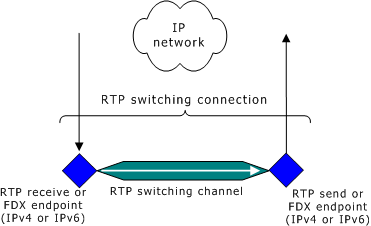
Applications can also use switch channels to route voice data to more than one RTP (IPv4 or IPv6) endpoint. This mechanism allows applications to monitor the voice data transferred across a particular voice channel. The following illustration shows the components used to connect voice data to multiple RTP endpoints.
When creating switching connections, the RTP endpoint that receives the incoming data must be either an RTP full duplex or RTP receive endpoint. The RTP endpoint that transfers the data back to the network must be either an RTP full duplex or RTP send endpoint. Because switching channels are always simplex (unlike voice channels which can be simplex or duplex), applications must connect two switching channels to create a full duplex connection between RTP endpoints. For more information about RTP switching connections refer to the Dialogic® NaturalAccess™ Fusion VoIP API Developer's Manual.