The MSPP service provides the following set of standard channels for processing and conducting data across the gateway:
RTP switching (or pass through)
Each MSPP channel is composed of one or more filters that carry out a set of operations with data that flows through the channel.
The MSPP service provides several filters for encoding and decoding data transferred between PSTN and packet networks according to standard algorithms. These filters include:
G.723.1/A
G.711
G.729A/B
G.726
In addition to encoding and decoding the data, MSPP voice encoding/decoding channels perform other operations such as buffering and reordering data frames to provide a steady flow of data to the DS0 endpoint.
The following channel components make up a typical full duplex MSPP voice encoding/decoding channel:
|
Filter type |
Description |
|
Voice decoders |
Decode and decompress voice data according to a particular algorithm. |
|
Voice encoders |
Encode and compress voice data according to a particular algorithm. |
|
Jitter |
Eliminate or reduce jitter in a packet sequence by buffering and rearranging the data frames in the correct sequence. |
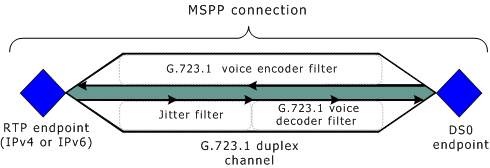
The following example shows the filters that make up a typical MSPP voice encoding/decoding channel. Although the encoder and decoder filters vary depending on the vocoding algorithm used (for example, G.723.1 or G.729A), the sequence of MSPP filters remains the same for different voice channels.
The following illustration shows the channel filters used in a full duplex G.723.1 voice channel:
Fusion T.38 fax connections use UDP packets to carry fax data over IP networks. At one end of the IP network a sending gateway converts analog fax data into digital form. It then encapsulates the data within UDP packets with an Internet fax protocol (IFP) header and a UDP transport layer (UDPTL) header, before sending the fax packets over the IP network. Another receiving gateway decodes the UDP fax packets and regenerates the analog fax signals.
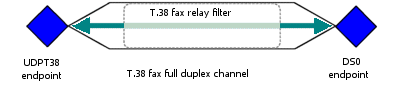
MSPP T.38 fax channels use a T.38 fax full duplex filter to convert digital fax data to analog form (modulation) and analog data to digital form (demodulation).
The following illustration shows a Fusion T.38 fax full duplex channel:
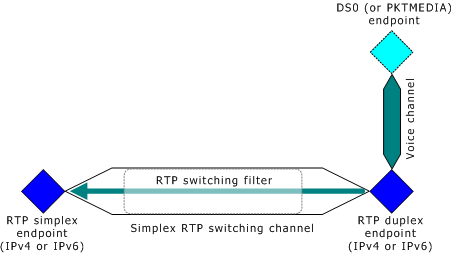
RTP switching channels act as pass-through filters for simplex data streams traveling between two RTP endpoints. RTP switching filters do not perform any processing tasks with the data that they carry between the RTP endpoints. Applications can connect RTP switching channels to IPv4 endpoints or IPv6 endpoints.
RTP switching channels enable applications to fork and switch RTP data streams to one or more destinations on the IP network. Applications can combine pairs of RTP switching channels (combined with RTP full duplex endpoints) to create a full duplex data path between two RTP full duplex endpoints. The following illustration shows an RTP simplex switching channel:
For more information about RTP switching and forking, refer to the Fusion Developer's Manual.