This section explains how to configure the AG and CG boards in the system to optimize the performance of a NaturalConference application.
To increase the number of members in a conference:
Chain conferences at the application level.
Disable capabilities either at the resource level or at the conference level. For example, disable coaching in one of the following ways:
At the resource level by setting the NO_COACHING flag in cnf.cfg.
At the conference level by setting the CNF_NO_COACHING flag in cnfCreateConference.
This topic presents the following information:
The following table describes the factors that can limit the number of members that a conferencing resource can manage:
|
Limiting factor |
Description |
|---|---|
|
DSP memory limitation |
Can occur on an AG board when using echo cancellation with 20 ms tail. This limitation causes the lowest DSP capacity by allowing no more than nine members per DSP. |
|
MIPS limitation |
Set at 133 MIPS per DSP on CG boards. This limitation factor applies when using a MIPS consuming capability like echo cancellation and tone clamping. This limitation is reached on the master DSP when implementing a spanned conferencing resource. When using echo cancellation, the lowest DSP capacity reached is 16 members per DSP. |
|
Number of voice channels a DSP has access to |
On AG boards, a DSP has access to 64 voice channels bringing the overall limitation of members per conferencing resource to 64. This number may vary depending on the capabilities being used versus the number of DSPs working together as a single resource. On CG boards, all DSPs are connected in groups of four to streams with 128 channels. Therefore, all DSPs can support up to 32 members. |
|
Number of members |
When coaching is not used, a single conference can use the full conferencing resource. If coaching is used in a conference, the number of members per conference is limited to 32. On AG boards, there is a limit of eight active talkers per conference. On CG boards, the limit is 16. |
|
Private link |
A private link can be implemented between each DSP according to each board type. Because a private link does not exist on AG boards, the previous limitation (number of voice channels) is the actual limitation on AG boards. On CG boards, private links exist in some DSP groups. This private link enables you to bypass the previous limitation so you can implement the master/slave model (spanned resource). Because DSP organization is board type dependent, refer to the readme file and to the sample NaturalConference configuration files delivered with the software to understand which DSPs can be used together to build a spanned conferencing resource. |
|
Switching matrix limitation |
Members are connected to conferencing resources through the switching matrix, regardless of whether the member comes from the CT bus or from the local trunks. The primary limitation is the number of connections to and from the CT bus and can vary according to each board family, model, and revision. The limitation can be 128 duplex (256 connections), 256 duplex, 2 x 256 duplex, or more. Refer to the board-specific documentation for information about the actual switching limitations. |
The actual conferencing resource capacity is variable and sometimes dynamic. To obtain precise numbers, the configuration must be installed and the conferencing firmware loaded onto the DSP.
Run the cnfinfo utility delivered with NaturalConference for a detailed list of the capabilities being used and the precise capacity for each conferencing resource configured. The readme file delivered with NaturalConference describes the firmware, its characteristics, and information about its capacity.
Consider the following performance limitations:
AG board:
With 20 ms echo cancellation: 12 members per DSP
With 10 ms echo cancellation: 16 members per DSP
Without echo cancellation, DTMF, and tone clamping: 32 members per DSP
Maximum number of DSPs being used in a single conferencing resource (spanning): 16
Maximum capacity per conferencing resource: 64 members
CG board:
With 20 ms echo cancellation: 12 members per DSP
With 10 ms echo cancellation: 16 members per DSP
Without echo cancellation, DTMF, and tone clamping: 32 members per DSP
Maximum number of DSPs being used in a single conferencing resource (spanning): 8
Maximum capacity per conferencing resource: 128 members
You can manage the available members for a conference in the following ways:
Use cnfGetResourceInfo to determine how many members you can add to a conference. This function gives you the maximum number of members the resource can accept if using the full capabilities of the resource, as well as the number of members available for a new conference.
If you know before opening the resource that you never use certain capabilities, disable the capabilities in the cnf.cfg by using the Flags keyword as described in NaturalConference configuration file statements. The information retrieved by cnfGetResourceInfo will be closer to your needs.
If you intend to create a conference using fewer capabilities than the resource allows, specify the unused capabilities for this resource in the CNF_CONFERENCE_PARMS structure when you create the conference. When the conference is created, you may have more available members on this resource than you expected. Then you can invoke cnfResizeConference to increase the number of available members. If you resize your conference progressively (adding one member each time) you will reach the real limit of the resource.
The following example illustrates resource management:
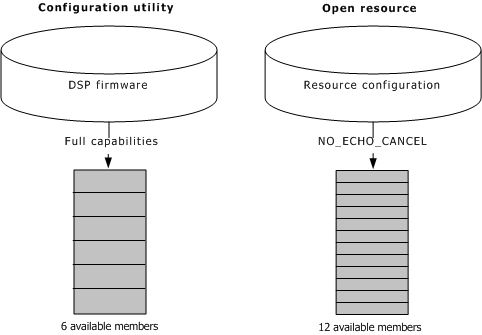
A call to cnfGetResourceInfo indicates that the resource can handle six members with full capabilities.
Because the application does not require echo cancellation, the keyword flags=NO_ECHO_CANCEL is specified in the cnf.cfg. The resource is opened and cnfGetResourceInfo is invoked, indicating that the number of available members has increased to 12.
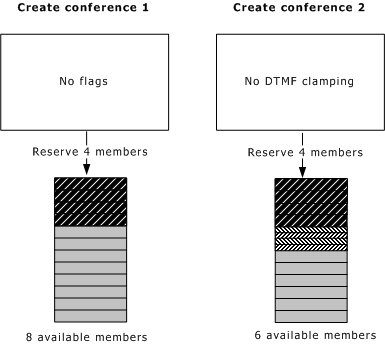
A new conference with full capabilities and four members is created, reducing the number of available members to eight.
When a second conference with no DTMF clamping and four members is created, the number of available members is only reduced by two (to six available members).