Video Access runs on NMS CG boards in the Natural Access environment. To completely understand Video Access, it is important to have a general understanding of certain Natural Access concepts. This section describes those Natural Access concepts on which Video Access builds. For more information about Natural Access services, refer to the Natural Access manuals on the NMS web site.
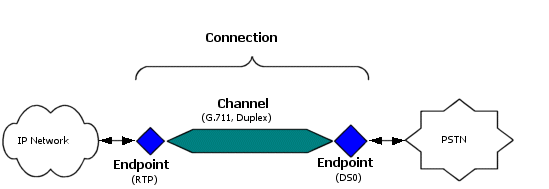
The Natural Access Media Stream Protocol Processing (MSPP) service provides functions for creating media channels between endpoints established at different ends of a Fusion gateway. The MSPP service creates and controls audio and video RTP endpoints.
Applications use the MSPP service to create and control the following components:
|
Component |
Description |
|
Endpoints |
Entry and exit points for data that passes through MSPP channels. |
|
Channels |
Linked sets of functions that transform a real-time flow of media from one network format to another. Channels can either carry data in two directions (duplex) or one direction (simplex). |
|
Connections |
One-way or two-way data streams through the gateway created by associating MSPP endpoints with MSPP channels. When connections are enabled, data flows through the associated channels to the connected endpoints. |
When an application connects an MSPP channel to two MSPP endpoints, it forms a complete MSPP connection. Enabling the connection allows data to flow through the gateway from one network interface to another. The following illustration shows MSPP service connection components:
MSPP endpoints and channels are used in Video Access for both the 3G-324M Interface and the Video Messaging Server Interface. For more information, refer to Creating an endpoint in the 3G-324M Interface Developer's Reference Manual and Creating endpoints in the Video Messaging Server Interface Developer's Reference Manual.
Each MSPP connection consists of a linked set of MSPP filters. An MSPP filter is a task or process that performs an operation or set of operations with data that flows through it. All MSPP endpoints and channels are made up of one or more filters that perform specific tasks with the data they receive. Cumulatively, these filters carry out all the tasks performed by the endpoints and channels that make up the connection. The following illustration shows the filters that make up a typical voice channel:
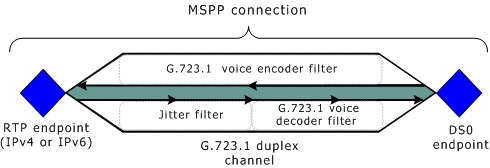
MSPP endpoints and channels use filters in the following way:
Endpoints are made up of a single filter that translates data between a network specific transport format (for example, PSTN/DS0 or UDP/RTP format) and a media-specific format (for example, G.711 voice or H.263 video).
Channels consist of one or more MSPP filters that perform specific tasks with data as it moves from one endpoint to another (for example, jitter buffering).
Applications can use MSPP service functions to send commands and queries to the filters that make up standard MSPP service endpoints and channels. For more information about MSPP channel and endpoint filters, refer to the MSPP Service Developer's Reference Manual.
The ADI service is a component of Natural Access that enables applications to execute multiple telephony functions on NMS Communications boards and software, including CG boards. The application accesses multimedia play and record functions through the ADI service. For more information on the ADI service, refer to the ADI Service Developer's Reference Manual.
Note: The use of the ADI service for Video Access is limited to the play/record functionality of the Video Messaging Server.