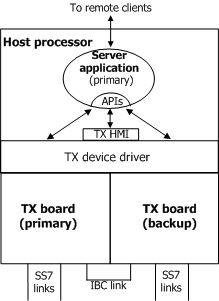
The Health Management system can support the following reference configurations:
In the single-node and dual-node configurations, the signaling application is referred to as a signaling server, providing service to one or more signaling clients. The client-server model illustrated here is a common architecture for distributed call-processing applications, but others are possible. The choice of application model is up to the system designer.
This topic describes the Health Management system reference configurations. For SIGTRAN installations, replace the SS7 links with Ethernet links in the configuration illustrations.
For more information about setting up redundant configurations, refer to Board installation and cabling.
A single-node configuration uses two TX boards in a single-node (chassis) for board level redundancy. In this configuration, a single application monitors and controls the primary and backup boards and performs all other application functions. This is the simplest migration path for an existing non-redundant application to a redundant signaling subsystem.
A single-node redundant signaling subsystem can survive both signaling link and board failures without a service outage. In addition, one board can be taken out of service at a time for upgrade or reconfiguration without impacting the service provided by the application.
A dual-node configuration uses two chassis, each with a single TX board for signaling. The dual-node model assumes a signaling server application that, like the TX boards, operates in a primary and backup manner. The primary and backup server applications communicate call states through an application-specific inter-process communication (IPC) mechanism.
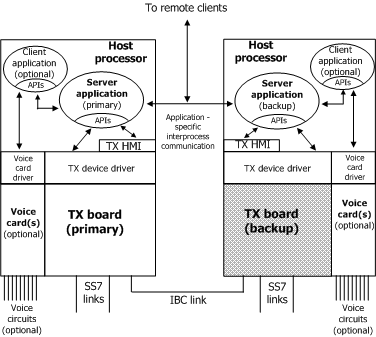
A dual-node configuration has the reliability attributes of the single-node configuration but can also survive a failure or planned outage (for upgrade or reconfiguration) of an entire node without a service outage. The cost of this added reliability is in the increased complexity of the server applications. In a dual-node configuration, monitoring and control of the boards must be shared between applications on each node. If active calls or transactions are to be maintained across an outage, state information must also be exchanged between nodes.
A standalone configuration consists of a single non-redundant signaling board in a single node. In this configuration, the Health Management service monitors the board for failures and takes corrective action, such as reloading the failed board or notifying maintenance personnel.
A standalone configuration does not have the availability properties of a redundant configuration, but the Health Management service can still be a valuable tool for quickly detecting failures and minimizing the duration of the service outage that results.