This topic presents:
NaturalAccess employs an asynchronous programming model to take advantage of concurrent processing. When called, most functions return immediately indicating the operation was initiated. The application can then perform other functions while NaturalAccess is processing the command.
There are two types of functions in NaturalAccess:
|
Function type |
Description |
|
Synchronous |
Complete when the return value is received. The return value may be either SUCCESS or an error code. |
|
Asynchronous |
Returns events that indicate the success or failure of the operation. If the operation fails, it may return the reason for this failure in the value field of the event. |
During the function execution, events are generated indicating the occurrence of certain conditions or state changes. If an asynchronous function fails after being initiated, NaturalAccess delivers a DONE event to the application and the event value field contains an error code.
The following table summarizes the differences between asynchronous and synchronous functions. The Function summary section in this manual lists the USAI functions and indicates if they are synchronous or asynchronous.
|
Characteristic |
Asynchronous |
Synchronous |
|
Operation complete when function returns |
No |
Yes |
|
NaturalAccess returns a DONE event when function is complete |
Yes |
No |
|
Function can fail after function returns |
Yes |
No |
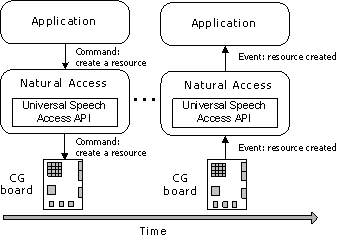
As shown in the following illustration, for asynchronous functions, NaturalAccess sends a command to the API, which sends a command to a telephony board. The board performs the requested functions and sends events to the service indicating its state (for example, the function was started or the function is complete). The API sends events to NaturalAccess, which makes them available to the application. The following illustration shows NaturalAccess and the Universal Speech Access API interaction:
For detailed information about NaturalAccess, refer to the Dialogic® NaturalAccess™ Software Developer’s Manual.
NaturalAccess Fusion API is a voice-over-IP media streaming development environment. The MSPP API enables applications to establish connections by creating media streaming endpoints and channels. The service provides a standard set of endpoint and channel types with which to build these connections. For more information, refer to the Dialogic® NaturalAccess™ Fusion™ VoIP API Developer’s Manual.
NaturalAccess OAM API manages and maintains telephony resources in a system, including:
Hardware components, such as CG boards.
Software components, such as the Hot Swap process.
Using the NaturalAccess OAM API, you can:
Create, delete, and query the configuration of a component.
Start (boot), stop (shut down), and test a component.
Receive notifications from components.
Software processes supported by NaturalAccess OAM API include:
Hot Swap: the ability to insert and extract CompactPCI boards without powering down the system.
Clock management: the ability to configure the CT bus clock across all boards in an H.110 system.
For more information about NaturalAccess OAM API, refer to the Dialogic® NaturalAccess™ OAM System Developer’s Manual.
Note: NaturalAccess OAM API operates only when the NaturalAccess Server (ctdaemon) is running.